 Picture : -
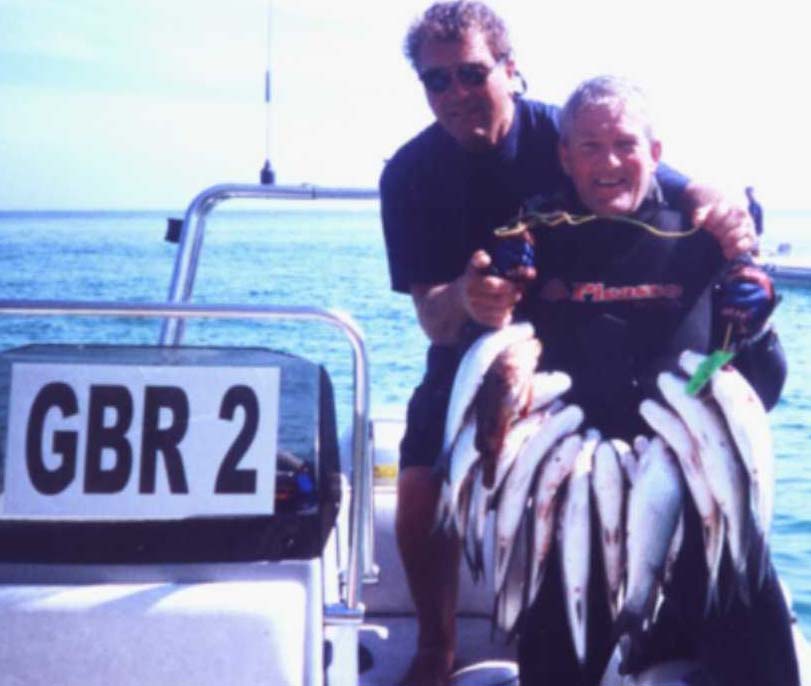
Peter Crawford and Dave O'Callaghan after day 2 of the competition.
Picture : -
Peter Crawford and Dave O'Callaghan after day 2 of the competition.The 24th European Championships:
Lagos, Portugal
The car park on the cliffs overlooking Praia da Mareta was the ideal spot for our first look at the area. There was a huge swell running into the bay and the visibility could have been measured in inches! Not the start we had all hoped for.
Our journey to Sagres had been very straight forward except for the usual performance over weight belts at Gatwick airport. We had watched the badgers feeding at Micks house, grabbed four hours sleep and left Gatwick on time at 6.30 a.m. At Faro Airport we collected the two hire cars, both of which had the bonus of air conditioning [thrown for free]. Our first day on the Algarve had stated sunny and warm. In fact we didn’t see a cloud in the sky until the evening before the start of the competition.
We booked into the Hotel Navigator and found our rooms had fantastic views back down the coast toward Lagos. Members of the Greek Team were in Reception asking if their post had arrived. They had sent for thicker suits and we were soon to discover why.
After lunch we jumped into the cars and set out along the coast towards Cap San Vincente. One of the competition areas was from Sagres to Cap San Vincente and the other was from Cap San Vincente up the west coast. Everywhere we went the visibility was low and the swell was pounding up the cliffs. The swell was rising and falling at least twenty feet up the cliffs. It was going to be impossible to get into the water from the shore in these conditions and we were going to have to rely on scouting from the shore while all the other Teams were out in their Ribs. Does this sound familiar? Successive British Teams have earned their nickname of the Rock Hoppers.
Spirits were low on the return trip to Sagres. At the harbour the Spanish Team had just got their Ribs out of the water, they had been there for several weeks already. The ex Portugese international, Joao Rosario, had been out with his friend Pedro Carbonell helping him look over the area. Joao spoke very good English and was able to tell us the visibility would improve in two or three days time when the wind brought clear water up from Gibraltar. He also said that the water temperature had recently dropped from 26C to 15C. At least this should be in our favour and also explained why the Greeks wanted thicker suits. Joao insisted that the Spanish and British Teams should join him at a small café for a local delicacy. This turned out to be Moray sandwiches, each complete with a Moray head sticking out of the end! Judging from the expressions on their faces I don’t think our Spanish friends enjoyed this treat any more than we did.
Thursday 9th September.
Forty surfers were enjoying the ideal conditions in Mareta Bay. No point in trying to scout the area in these conditions. Decided to go fishing if we could find easier access into clearer water. Travelled back toward Lagos and eventually found slightly better conditions at Boca do Rio. The swell and poor viz. made fishing difficult but we did see and catch bream and mullet, which was encouraging.
There were two old, rusty, British registered camper vans at the top of the beach with a bloke in each. They had been there since January enjoying a very relaxed life style, which seemed to consist of drinking white wine in the morning and red in the afternoon. One of them had a friend in Britain who had been a spearfisherman. It turned out to be Stuart Walters – some of you may remember him as a very successful competitor in the early seventies when he won several Nationals. It’s a small world.
Friday 12th September.
Maureen and I drove to Faro to collect Graham Worley. The temperature on the motorway was 36C. Mick, Peter and Dave spent all morning and most of the afternoon looking for somewhere to dive. By late afternoon, the water was beginning to clear in Mareta Bay so Pete and Dave swam out along Pont da Atalaia – the most easterly point of the competition area. Both saw fish but unfortunately Dave lost his mask and snorkel in the surf as they got out at the end of the dive.
Saturday 13th September.
Very strong easterly wind (probably gale force) so offshore in west coast area. We had met up with Philip Diaz (ex Sussex club member) by this time and he had explained how we could use the unmade roads to access beaches on the west coast, so off we set for Praia do Telheiro. (Telheiro was also the name of Wally’s favourite restaurant in the area) Changing in the dusty car park on the top of the cliff was a nightmare in the strong wind. The climb down to the beach was in the same class as Rame Head but a lot of ground was scouted and some good fish seen. All day the other Teams were going up and down the area in their Ribs. We had tried to hire a Rib in Sagres Harbour but had been quoted 40E an hour plus fuel! There was no way we could afford this but luckily Philip Diaz had uncles who were persuaded to take us out for less. We could still only afford two days scouting by boat.
Sunday 14th September.
Uncle number one was going to take us out but would only take three persons. The viz. had improved and the swell had dropped off. Mick, Graham and Dave went to Cap San Vincente in the boat and looked at the inaccessible parts of Area B. Meanwhile Maureen dropped Pete and I off at Praia de Tonel so that we could swim around Ponte do Sagres to Mareta beach. We saw fish in hotspots on both sides of the headland. There were many very good bream up to 3 or 4 kilos in weight, big bass up to 3 kilos and big grey mullet in depths down to 20 metres but the fish were definitely more friendly among the boulders at 20 metres than they were on the cliff edge. It turned out to be a five-hour swim but well worth the effort. I rated this as one of my top ten dives of all time. Mick, Dave and Graham had also seen fish at the other end of the area so everyone was feeling more relaxed and confident.
Monday 15th September.
Uncle No.2 would take four divers out in his boat so Pete joined the others to look at Area A on the far side of Cap San Vincente. The sea was very rough between Sagres and Cap San Vincente because of the strong SE wind and the big swell. It was calmer up the west coast but it still took 1.5 hours to reach the far end of Area A.
The boat returned to Sagres Harbour at 5.30 that evening. We had arranged to move from Sagres to the Marina Club in Lagos from where the Competition was based so Maureen and I had moved a good proportion of the Teams luggage during the day. The Marina turned out to be a four star, state of the art, Aparthotel. Having settled into the Marina Club we set out to find somewhere to eat at about 9.0 p.m. Running alongside the marina are a number of good restaurants, which we walked past scanning the menus. Mick suddenly shot into one restaurant went up to a lady and kissed her on the cheek! We had made contact with Sue and Wally Pack who had come down to support the Team. They had already ordered so we moved on to find somewhere cheap and cheerful and quick. We found people queuing outside of what turned out to be a huge barn of a restaurant called the Adega de Marina. It proved to be cheap and quick but the staff were far from cheerful and was nicknamed the ‘soup kitchen’. We decided it wouldn’t be getting our custom again. How wrong we were – this was the official eatery for the competition and all the meals for the Teams for the four days were provided there. To be fair our first impression was a little harsh as the food turned out to be almost acceptable but far below anything else we ate on the Algarve.
We returned to the Marina Club to find Adrian and Marion Worley and Ron and Shirley Jacobs sitting on the terrace by the pool. Wally and Sue joined us so the British contingent was there in full. We spent pleasant hour or so chatting and got to bed later than previously.
Tuesday 16th September.
Mick, Pete, Dave and Graham were along the corridor from Maureen and myself. At 8.15 a.m. I was hammering on their door and getting no reply, I didn’t like to shout too loudly in such a posh Hotel. They later claimed to have all been up and I hadn’t banged loud enough for them to hear. Eventually set off to another surfing beach at the top end of Area A at Ponta Ruiva. A very steep dirt road led to a car park where the surfers had already set up a ‘village’ of camper vans. This turned out to be another good days scouting with some excellent ground and good fish. The Team were keen to start Day 1.of the competition here. One of the advantages of ‘rock hopping’ is that you swim across bays and don’t just dive on the more obvious Headlands. Apart from the Portugese no other team seemed to have found this ground so we had it to ourselves for most of the day.
We stopped to talk to Philip Diaz in Sagres and ate at his restaurant – Atlantico. Later that evening Pete and Mick showed their culinary expertise and prepared a fine meal for all of us. Early to bed.
Wednesday 17th September.
I was able to collect essential information and goodies from the competition office: tee shirts, caps, float and handed in our flag and anthem. Time to do some fishing rather than scouting. Set off to Amado beach up the coast at Carrapateira only to find Phil and his girlfriend were already there along with the surfers! I didn’t need to practice hitting fish – I didn’t have a gun anyway – so I decided to take a chance on swimming straight out to sea looking for rocky outcrops. After about half a mile of swimming, the sandy bottom changed to low, smooth, rock sparsely covered with that funny flat bladed kelp. Here in 50 ft of water there were a lot of good bream and with me not having a gun, they seemed quite unconcerned. I was concerned because I wondered if we had not been able to find similar reefs in the competition areas that the other teams with their fish finders and GPS would have been able to locate. In the end it appeared that we had only missed one important reef in Area A and non at all in Area B.
By the time that we got out of the water Shirley, Marion, Ron and Adrian had found us. The team were generally disappointed with their catch of about 15 fish but they had a good mixed bag of bream, mullet, wrasse and conger.
Thursday 18th September.
Last chance to look at area. Castelejo beach gave us access to the very top end of Area A that we hadn’t looked at so far. Maureen and I had come to Castelejo five years ago and walked across the sandy beach to the next headland. The beach is now covered in boulders and very large pebbles. Phil Diaz had shown us photographs of a wave that had come up from the Azores on 15th March this year that had reached the top of the cliffs – 200ft. Once again the surf made entry into the water difficult but the team bravely plunged in and were soon outside the line of the breakers. Unfortunately this area proved rather disappointing but might provide the odd fish if necessary. Our worst fears are confirmed. All the meals will be at the Adega de marina.
Friday 19th September.
We all dressed in our Team uniform and made our way down to Henri the Navigator Square for the official parade to the Fort da Bandeira where the opening ceremony was held. At the precise moment that the competition was declared open, a passing seagull did what seagulls do best and shat on the British and Portugese Teams. Both teams took this as a good luck sign! A superb buffet had been laid on by the Lagos Town Council and the Club de Vela (the local sailing club which also organises spearfishing locally).
The Captains (Managers) Meeting that afternoon was the usual mixture of wheeling and dealing but nothing that might have disadvantaged us. Would you believe it, once again the British Team drew the smallest, least powerful boats for our fishermen but the fastest boat for the Manager. I have to say it was a fair draw and we were just unlucky. That evening I needed some information so I went to see Pedro in the Competition Office. By then all the necessary equipment had been allocated to the boatmen but ominously the GB3 equipment was still on the table. I didn’t dare tell Mick that his boat hadn’t turned up.
Saturday 20th September.
Up early for the first day’s competition in Area A. It was decided that it was too rough to go from Lagos to Sagres by sea, a distance of some 30K, so all the boats were trailed to Sagres and launched there. It took just a little over an hour to get all sixty odd Ribs from Lagos and have them on the water and ready to go – a brilliant effort. As I suspected GB3 was a smaller, less powerful substitute boat and I felt obliged to give Pedro a really hard time over it. As it turned out, Mick actually had a very good boat and an excellent boatman called Fernando Danas. We had two Marshall 60 Ribs 0f approximately 4 metres with 40 HP engines and two Joker boats, one with a 50 HP engine and mine with 115 HP on the back! The Marshall 60’s turned out to be perfect boats for spearfishing in rough conditions. They were able to zip about more quickly than the larger boats in these rough conditions. It says much for the quality of the boats provided that there was no serious problem with any of them.
The flotilla left Sagres Harbour and encountered rough seas all the way to Cap San Vincente. Rough enough in fact for Dave’s boatman, Pedro Monteiro, to lose his mobile phone as it bounced off the console and disappeared over the stern of the Rib. Once past Cap San Vincente and into Area A, the sea calmed leaving only a moderate swell and an off shore wind. All the boats gathered for the start in the middle of the area. Surprisingly we were going to start on time at 10.0 am for the five hour competition. The Controller raised the signal horn and pressed the trigger. Nothing happened! A whistle was quickly produced and blown. We were off. Dave had a dream start when Pete put him right on top of a split full of bass. Within a few minutes of the start, Dave had boated a beautiful 4.175 Kg fish. Shortly afterwards, Mick topped this with a fine 5.135 Kg bass. Mick carried on fishing steadily to end the day with a catch of 15 weighing fish for 12th place on the first day. Graham worked hard all day to weigh in 5 fish while Dave recorded 4. When the boats gathered at the end of the first day, the Portugese and Spanish divers were busy showing off their fine catches. The value of many days in the area showed in the number of hole fish – Grouper, Rockling, Conger and Moray – that they had caught. Each competitor was only allowed one Grouper. Alberto March had two Grouper and could only weigh in the smaller, which had been caught first. At the weigh in this Grouper was a few grammes under the minimum weight and was discarded. If the larger Grouper had been allowed, he would have won the first day. As it was the reigning world champion Pedro Carbonell of Spain weighed in 35 fish to win the first day. Andre Domingues of Portugal lay in second place with 23 fish. Great Britain were lying eighth at the end of the first day.
Sunday 21st September.
Day Two again started with the drive to Sagres to board the Ribs. All went smoothly until Dave’s boatman, Pedro, (the one that had lost his mobile) slipped off the side tube of his Rib and took a nasty knock to the knee on the corner of the console. The medics were unsure of the extent of the damage but in spite of being in obvious pain Pedro insisted on taking the boat out.
On the way to the harbour we had stopped to look into Area B from the cliff top. Today was going to be very difficult. The wind was still blowing strongly from the east but a huge swell was rolling in from the southwest. Waves were surging 20-30 ft up the cliffs in exposed areas. The competitors were going to have a hard day fishing in rough water and low viz.
Straight from the start, the Team spread out along the east side of Ponta do Sagres. It didn’t pay off; the fish had reacted to the changed conditions and moved out. Dave was left in this area to plug away steadily looking for his 12 Mullet and anything else he could find. Mick and Graham moved to the ground under Beliche Fort. Conditions here were difficult with a swell and low viz. Both divers were seeing fish on most dives and stayed here catching their quota of Mullet and a handful of other fish. Meanwhile, Dave had managed to catch 15 fish.
At the weigh in, Mick recorded 14 fish, Graham an excellent 18, including a fine Saima (zebra bream) of 3.31 Kg. Dave was very unlucky to have four fish; all less than 10 grms under the weight limit of 500 grms and weighed in 11 fish. This placed the Team sixth on the second day and pulled the GB Team up to sixth place over the two days.
Every competition has its share of ‘if onlys’ and in this case if only Daves marginally underweight fish had weighed we could have finished fifth. GB had beaten Greece who had spent at least a week longer in the Algarve and had their own Ribs with them. Spain had spent at least a month in the area and were helped by two ex Portugese internationals, so it was particularly satisfying to see Mick Veal finishing 12th and Pablo Bardisa of Spain thirteenth. My target for the Team had been a finish of no lower than 6th and this had been achieved. Well-done Mick, Graham and Dave, and Peter Crawford for his support and expertise.
A good team effort.
The presentation dinner on the Sunday evening was attended by all those who had helped with the competition and the team supporters. The British contingent consisted of: The Team, Shirley and Ron Jacobs, Sue and Wally Pack, Marion and Adrian Worley and Maureen. Their support and help during the week was much appreciated by the Team. As usual on these occasions the meal was followed by many speeches and the presentation of many excellent trophies including one very special trophy to Peter Crawford for his spearfishing excellence over the past thirty years or so.
Monday 22nd September.
Up late, packed, time to wander round the excellent shops in Lagos and to say good-bye to the many friends we had made, including a trip out to Sagres to say cheerio to Phil Dias and to thank him for his support during our stay.
Reflections
A good competition. The organisation was excellent with reasonably fair fishing conditions and very friendly Portugese. Many think this was the best Europeans ever and a very high standard has been set for future competitions. We have now qualified for the next world championships, which have been confirmed as being held in Iquique, Chile, September 2004. Wally Pack, Terry Thomas, Bob Milverton and I were in Iquique in September 1971 on the previous occasion that the worlds were held there. All of us will tell you that this is an experience not to be missed.
Alan Mills Team Manager
Picture : -
Peter Crawford and Dave O'Callaghan after day 2 of the competition.